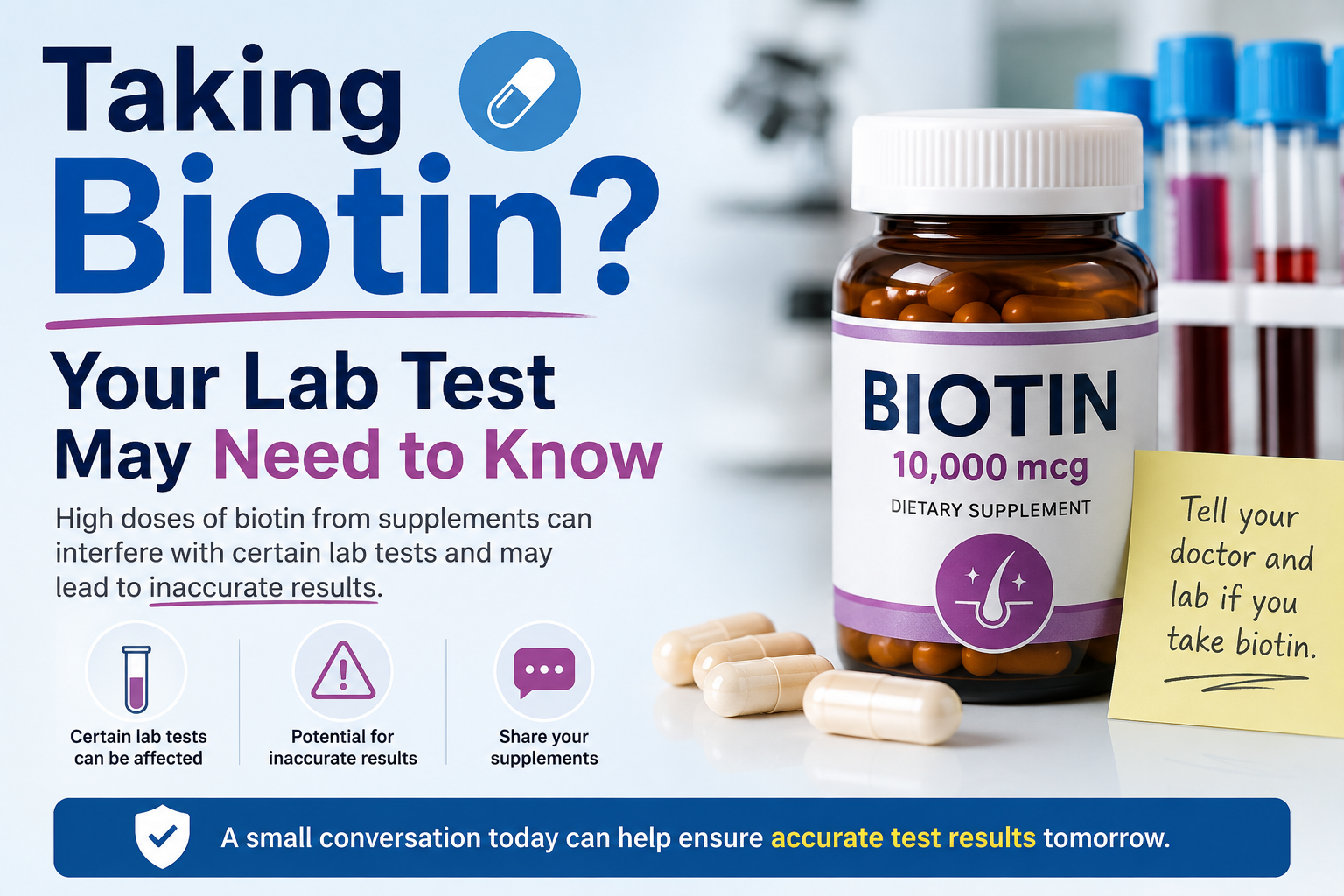
Biotin appears in many dietary supplements, especially products marketed for hair, skin, and nails. It can also be found in multivitamins and B-complex supplements.
That may seem unrelated to a blood test.
But there is an important detail many supplement users do not know:
Biotin can interfere with certain laboratory tests and potentially produce inaccurate results.
The issue is not that biotin necessarily changes what is happening inside your body. Instead, high amounts of biotin in a blood sample can interfere with the technology used by some laboratory tests.
That distinction matters.
Understanding it can help you have a more informed conversation with your doctor, pharmacist, or laboratory professional before testing.
What Is Biotin?
Biotin is a water-soluble B vitamin, also known as vitamin B7.
The body needs biotin for several metabolic processes involved in converting nutrients into energy.
Biotin occurs naturally in foods, and it is also widely available in dietary supplements.
Some supplements contain biotin as part of a multivitamin or B-complex formula, while products marketed for hair, skin, and nails may contain substantially more than the amount people normally obtain from food.
This is where an unexpected issue can arise.
How Can a Vitamin Affect a Lab Test?
The important word is interference.
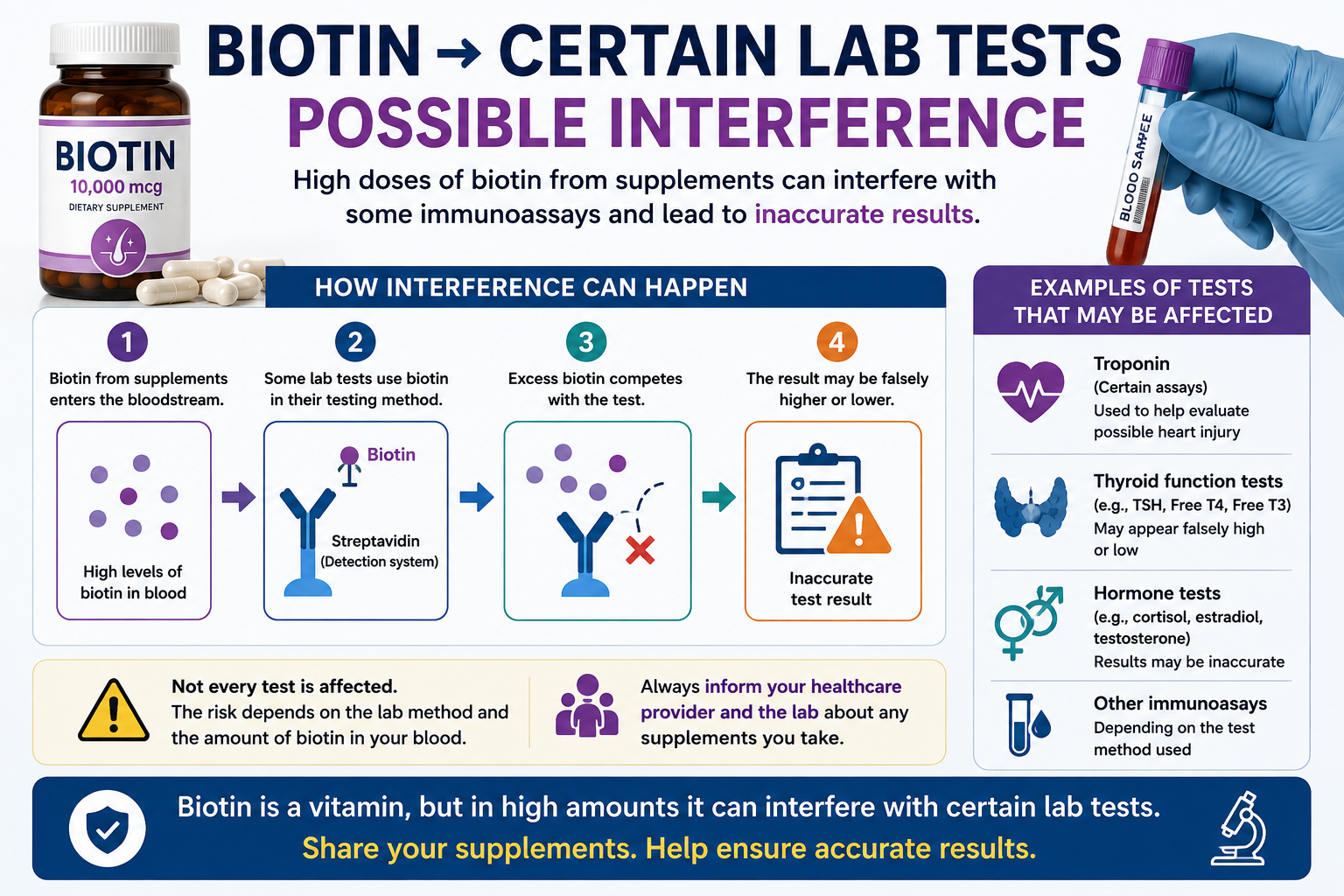
Some laboratory testing systems use interactions involving biotin as part of the method used to measure substances in a blood sample.
When enough supplemental biotin is present in the sample, it can interfere with certain assays.
As a result, a laboratory value may appear higher or lower than it actually is, depending on the type of test.
This does not mean every blood test is affected.
It also does not mean everyone who takes a supplement containing biotin will receive an incorrect result.
The risk depends on factors including the test method being used and the amount of biotin present.
The U.S. Food and Drug Administration has specifically warned health professionals, laboratory personnel, and consumers about this problem.
Why Can an Incorrect Result Matter?
Laboratory results are often used together with symptoms, medical history, physical examinations, and other information to make medical decisions.
An inaccurate result can therefore create confusion.
One important example highlighted by the FDA involves troponin, a biomarker that can be used when evaluating possible heart injury.
The FDA has received reports involving biotin interference that produced falsely low troponin results with some assays.
This illustrates why supplement information can be medically relevant even when a product seems completely unrelated to the reason for a blood test.
It Is Not Just “Hair Vitamins”
One reason this issue can easily be missed is that people may not think of vitamins as relevant medications or health products.
Someone might be asked:
“Are you taking any medications?”
and answer no.
But they may still be using:
- a hair, skin, and nail supplement,
- a multivitamin,
- a B-complex product,
- or another dietary supplement containing biotin.
This is why it can be useful to keep an up-to-date list of both medications and supplements.
Do not rely only on the product name.
Look at the Supplement Facts label and check whether biotin is one of the ingredients.
Should You Automatically Stop Biotin Before a Blood Test?
This is where overly simple internet advice can become a problem.
There is no responsible universal rule such as:
“Everyone should stop biotin exactly X hours before every blood test.”
Different products can contain different amounts of biotin, and different laboratory tests can use different technologies.
Your medical circumstances matter as well.
Instead of choosing an arbitrary time interval yourself, tell the health professional ordering the test and the laboratory that you are taking a supplement containing biotin.
They can determine whether it is relevant to the specific test and what steps, if any, are appropriate.
This is especially important because supplements should not be started, stopped, or changed in ways that interfere with medical care simply because of generalized online advice.
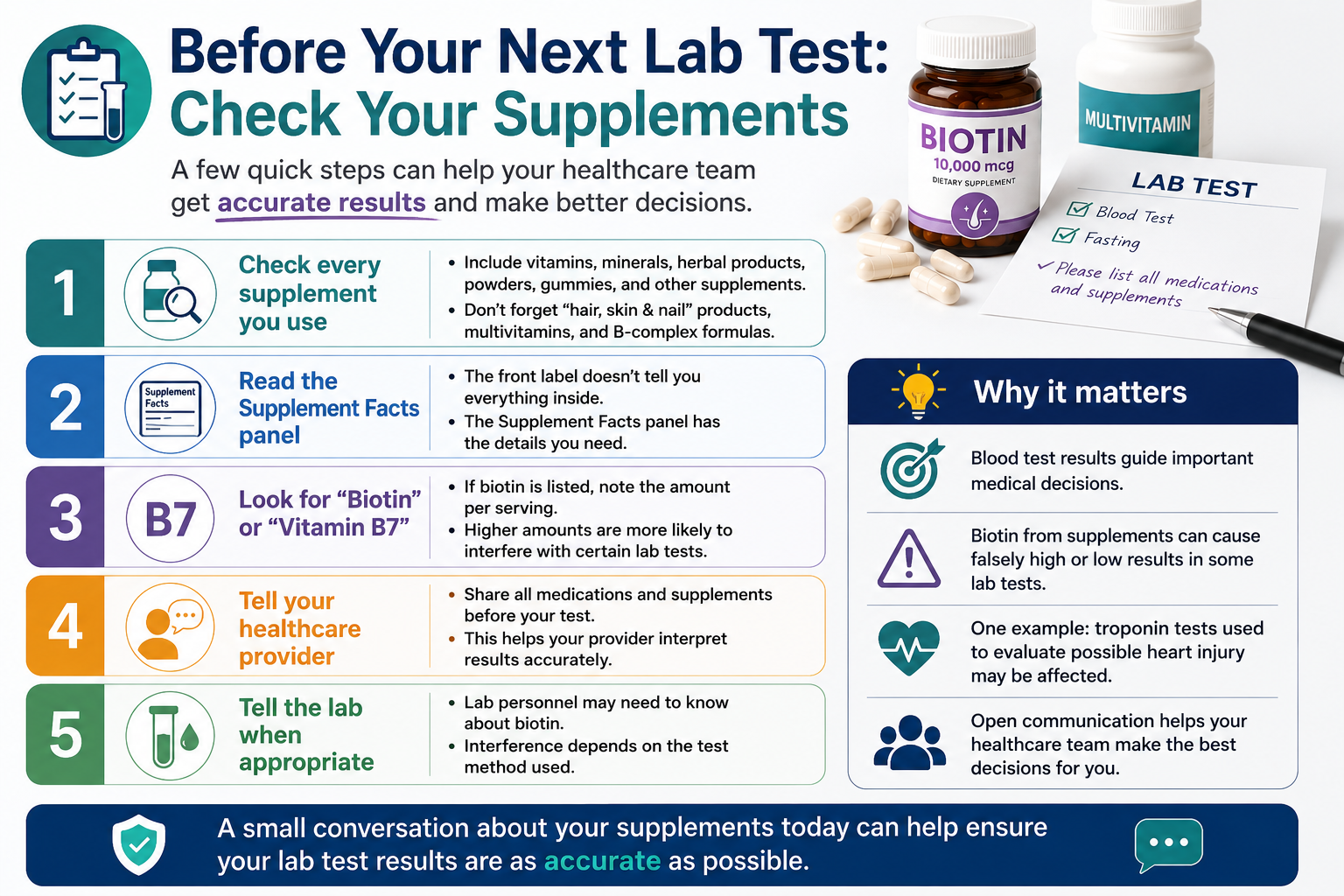
Five Things to Check Before Your Next Lab Test
Before laboratory testing, consider a quick supplement review.
1. Check every supplement you use
Do not check only products labeled “biotin.”
Review multivitamins, B-complex formulas, beauty supplements, powders, gummies, and other dietary supplements as well.
2. Read the Supplement Facts panel
Marketing on the front of the package may not tell you everything inside the product.
The Supplement Facts panel provides much more useful information.
3. Look for “Biotin” or “Vitamin B7”
If biotin appears on the label, note the amount listed.
4. Tell your health care provider
When discussing medications before a laboratory test, include dietary supplements.
This gives the health professional more complete information.
5. Tell the laboratory when appropriate
If you are taking biotin, laboratory personnel may need that information because interference depends partly on the testing method.
Supplements Can Affect Medical Care in More Ways Than People Expect
Biotin is also a useful example of a broader lesson about dietary supplements.
A supplement does not need to be a prescription drug to matter medically.
According to the FDA, dietary supplements may interact with medications, interfere with laboratory tests, or create problems around surgery in some circumstances.
That does not mean supplements are inherently dangerous.
It means they should be treated as relevant health information.
When a doctor or pharmacist asks what you take, a complete answer should generally include:
prescription medications + over-the-counter medicines + vitamins + minerals + herbal products + other dietary supplements.
That simple habit can reduce avoidable confusion.
The Bottom Line
Biotin is a vitamin, but that does not mean it is invisible to medical testing.
Certain laboratory assays can be affected by biotin in a blood sample, potentially producing inaccurate results.
The practical takeaway is not to panic or automatically stop every supplement before testing.
It is much simpler:
Know what is in your supplements and tell your health care team what you are taking.
Before your next blood test, take a minute to look at your supplement labels.
That small step may provide information your doctor or laboratory needs to interpret your test appropriately.
Health Information Notice
This article is for general educational purposes only and is not intended to diagnose, treat, cure, or prevent any disease. It does not provide individualized medical advice.
Do not stop prescribed medications or medically recommended supplements solely because of information in this article. If you take biotin or another dietary supplement and are scheduled for laboratory testing, discuss your supplement use with your doctor, pharmacist, or other qualified health professional.
References
- U.S. Food and Drug Administration (FDA). Biotin Interference with Troponin Lab Tests — Assays Subject to Biotin Interference.
- U.S. Food and Drug Administration (FDA). FDA 101: Dietary Supplements.
- National Institutes of Health, Office of Dietary Supplements. Biotin Fact Sheet for Health Professionals.