Hesperidin is often described as a “citrus antioxidant,” but that label leaves out one of the most interesting parts of the story.
Eating a compound is not the same as absorbing it.
And absorbing a compound is not the same as proving that it improves health.
Hesperidin provides a useful example of why those distinctions matter when evaluating dietary supplements and nutrition research.
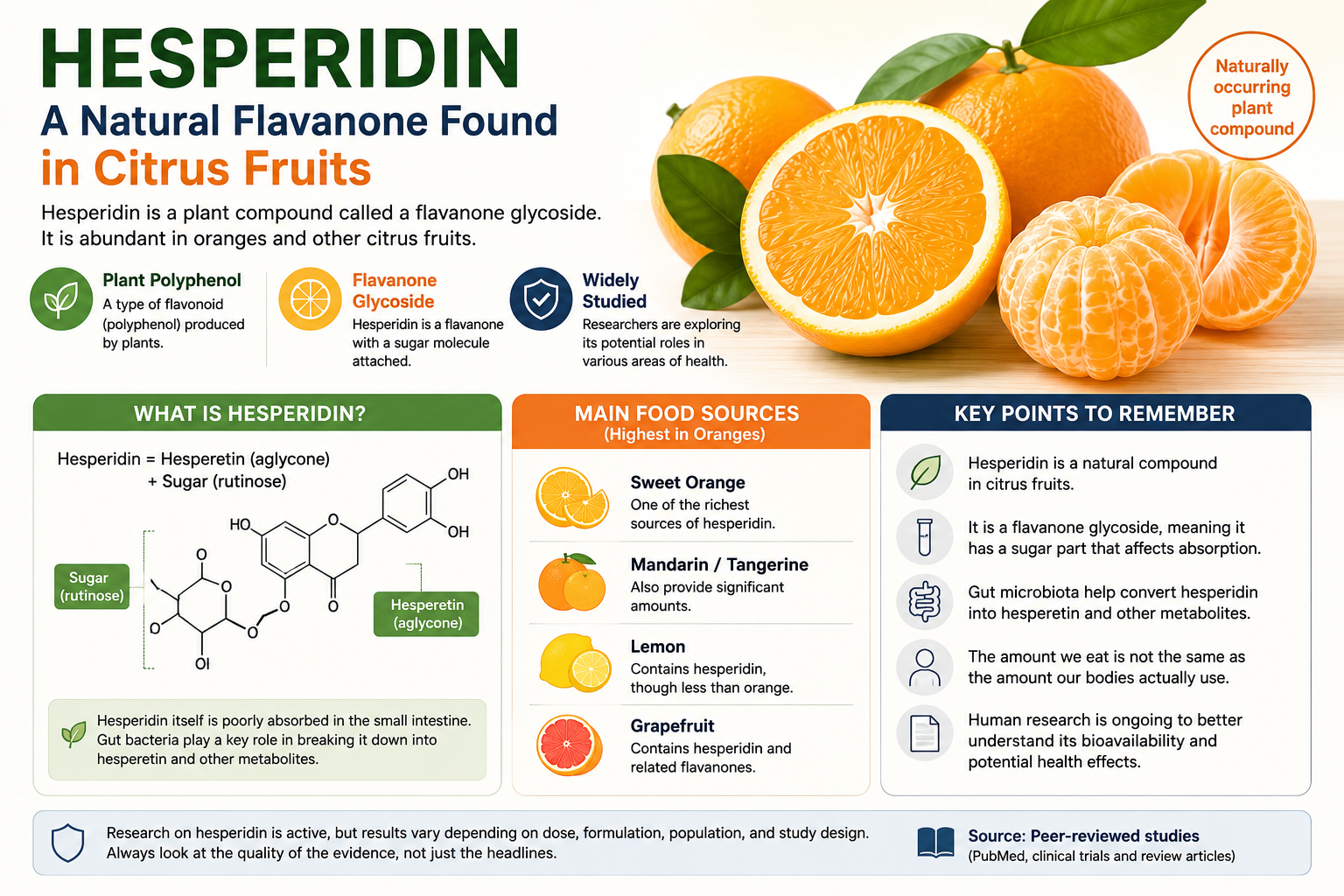
Found naturally in oranges and other citrus fruits, hesperidin belongs to a family of plant compounds known as flavonoids. More specifically, it is classified as a flavanone.
Researchers have investigated hesperidin in relation to vascular function, oxidative stress, inflammation-related biomarkers, and other aspects of human health. However, understanding those studies requires looking beyond claims about “benefits” and asking a more fundamental question:
What actually happens to hesperidin after we consume it?
Hesperidin Is Not Absorbed as Simply as a Nutrition Label Suggests
A supplement label may list a certain number of milligrams of hesperidin.
That number tells you how much is present in the product. It does not tell you how much will eventually appear in circulation or how much will reach different tissues.
This distinction is described by the concept of bioavailability.
Bioavailability refers, broadly, to the extent and timing with which an ingested compound or its metabolites become available to the body.
For hesperidin, the process is relatively complex.
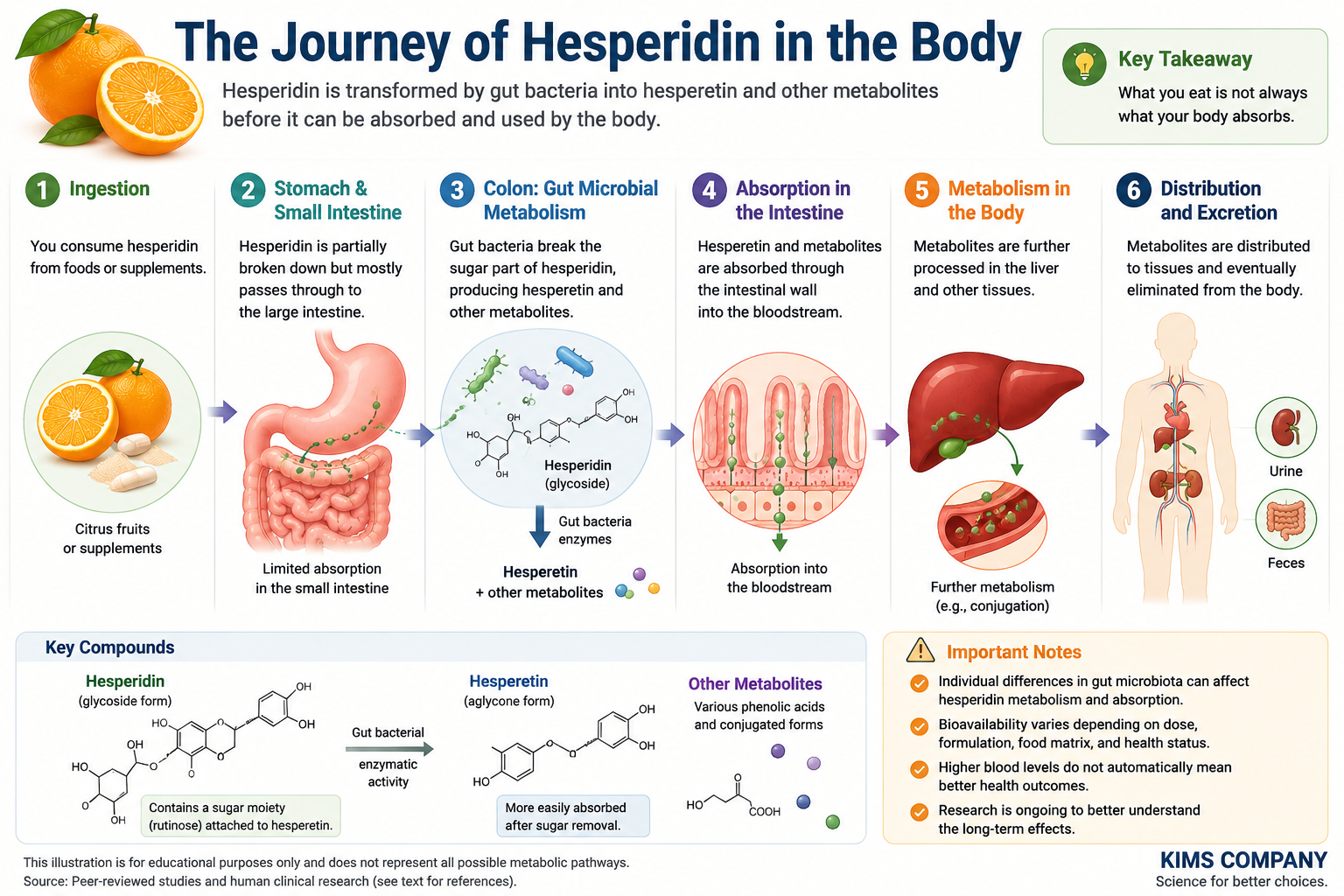
Hesperidin contains a sugar component attached to an aglycone called hesperetin. Much of ingested hesperidin is not immediately absorbed in its original form in the upper gastrointestinal tract.
Instead, a substantial portion can travel farther through the digestive system before being transformed.
That is where the gut microbiome becomes important.
Gut Bacteria Help Transform Hesperidin
Bacteria living in the colon possess enzymes capable of breaking chemical bonds that human digestive enzymes may not efficiently process.
Gut microbial activity can remove the sugar portion of hesperidin, producing hesperetin and additional metabolites that can then be absorbed and further processed by the body.
A simplified pathway looks like this:
Hesperidin intake → gastrointestinal transit → microbial metabolism → hesperetin and related metabolites → intestinal absorption → further metabolism
The real process is considerably more complicated, but this sequence explains an important point.
The compound listed on a supplement bottle is not necessarily the same chemical form that circulates in the body after digestion.
Why Two People May Handle the Same Dose Differently
Nutrition research frequently reports averages.
Individual biology, however, rarely behaves exactly like an average.
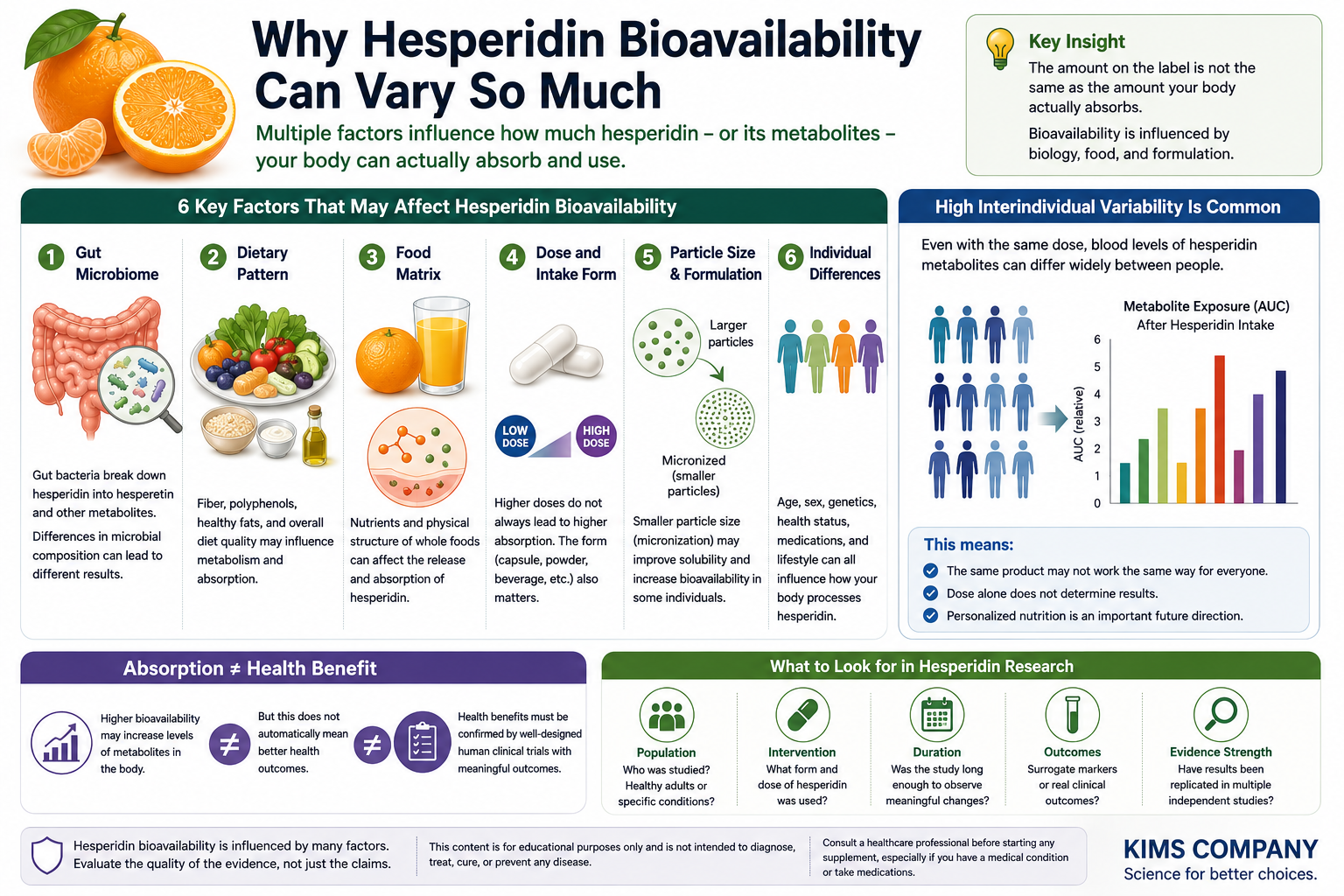
Gut microbial communities vary substantially between people. Differences in microbial composition and metabolic capacity may influence how efficiently hesperidin is converted into absorbable metabolites.
Researchers have therefore observed considerable interindividual variability in hesperidin metabolism and bioavailability.
Several factors may contribute, including:
- gut microbiome composition
- habitual diet
- gastrointestinal transit
- food matrix
- dose
- particle size and formulation
- individual metabolic differences
This means that two people consuming the same labeled amount of hesperidin may not necessarily experience identical systemic exposure.
That does not automatically mean one person will receive a greater health benefit. It simply demonstrates why dose alone does not tell the entire biological story.
Formulation Can Change Bioavailability
Hesperidin has relatively limited water solubility, which has led researchers to investigate different ways of improving its bioavailability.
One approach is micronization, which reduces particle size.
Human pharmacokinetic research has examined whether factors such as hesperidin stereochemistry and micronization influence exposure to hesperidin-derived metabolites.
A randomized, double-blind crossover trial in healthy adults reported differences in bioavailability depending on the form and particle characteristics of the hesperidin preparation.
That finding is scientifically interesting.
But it is also easy to misinterpret.
Better absorption does not automatically mean better health outcomes.
A formulation that produces higher concentrations of metabolites in blood or urine may have greater bioavailability.
That tells us something about pharmacokinetics.
It does not, by itself, demonstrate that the formulation reduces disease risk, improves symptoms, or produces a clinically meaningful health benefit.
Those questions require appropriately designed clinical trials.
What Have Human Studies Investigated?
Human studies involving hesperidin or citrus flavanones have examined several outcomes, including measures related to:
- vascular function
- blood pressure
- endothelial function
- inflammatory biomarkers
- oxidative stress
- cardiometabolic markers
The existence of human trials is encouraging because clinical research provides more directly applicable evidence than cell or animal experiments.
However, “human study” does not automatically mean “proven benefit.”
Trials differ considerably.
One study may use orange juice, another purified hesperidin. Participants may be healthy adults in one trial and people with specific cardiometabolic characteristics in another.
Dosages, intervention periods, formulations, sample sizes, and endpoints can all differ.
These differences make broad claims difficult.
Surrogate Markers Are Not the Same as Health Outcomes
This distinction is particularly important when reading supplement headlines.
Suppose a study reports a statistically significant change in a blood biomarker or a measurement of vascular function.
That result may be scientifically useful.
But it does not necessarily demonstrate that participants experienced fewer heart attacks, lived longer, avoided disease, or experienced a noticeable improvement in everyday health.
Researchers often use surrogate endpoints because major clinical outcomes can require large populations and years of follow-up.
Surrogate markers can help researchers understand biological effects, but they should not automatically be presented as proof of disease prevention.
This is one reason phrases such as “supports cardiovascular health” need to be examined in the context of the actual study outcome.
Orange Juice, Whole Oranges, and Hesperidin Supplements Are Not Equivalent
Another common mistake is treating every source of hesperidin as interchangeable.
They are not.
A whole orange contains water, fiber, vitamin C, carbohydrates, minerals, and numerous phytochemicals within a complex food matrix.
Orange juice has a different physical structure and nutritional profile.
A purified hesperidin supplement is different again.
The surrounding food matrix may affect digestion, absorption, and metabolism. Supplemental formulations may also provide concentrations that are difficult to obtain from ordinary food intake.
Therefore, evidence from a purified supplement cannot automatically be applied to whole citrus fruit.
The reverse is also true.
Benefits associated with a dietary pattern rich in fruit cannot automatically be attributed to hesperidin alone.
Five Questions to Ask Before Believing a Hesperidin Claim
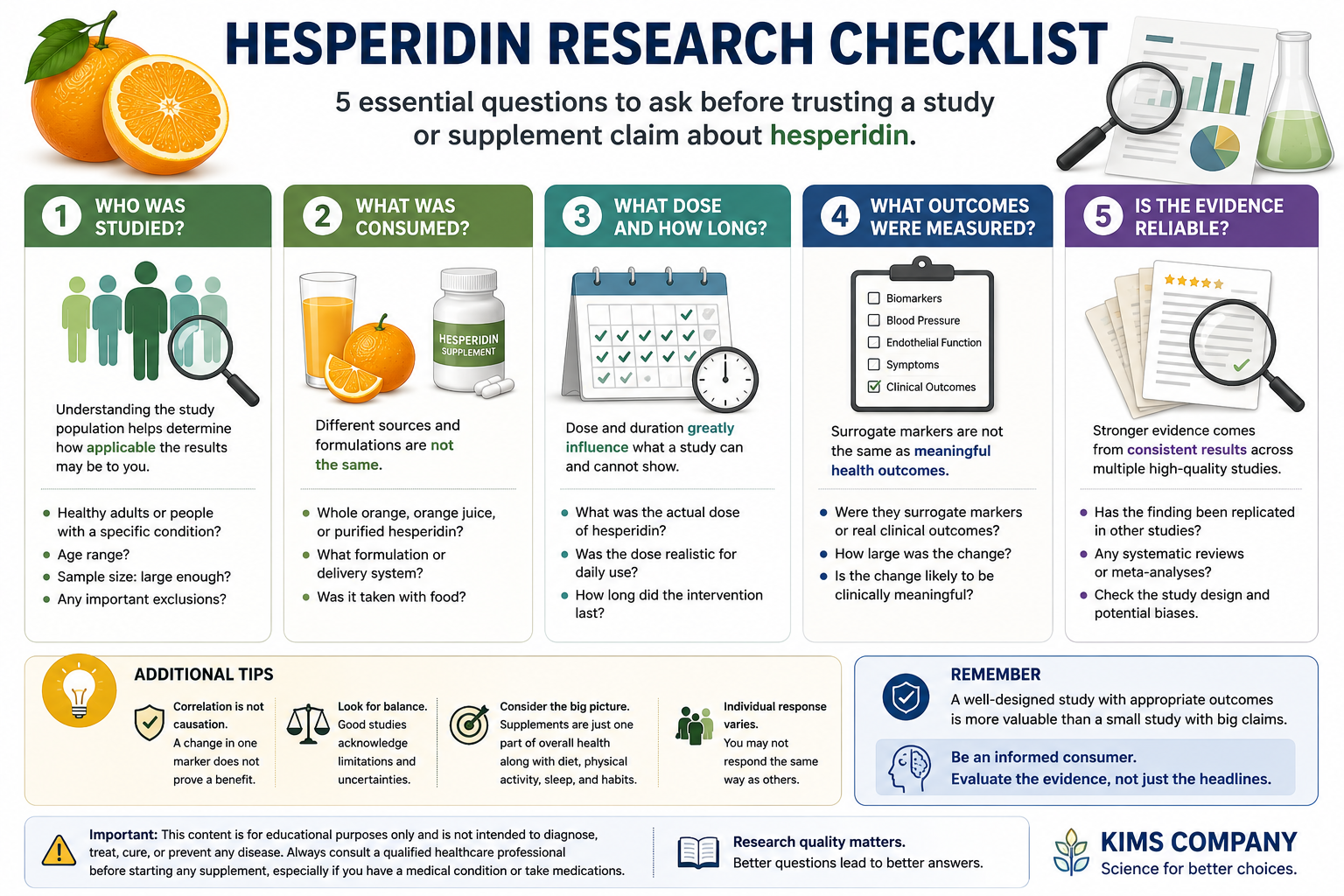
When you encounter a study, supplement advertisement, or health article about hesperidin, ask these questions.
1. Was the research conducted in humans?
Cell and animal experiments are valuable for exploring mechanisms, but they cannot establish the same level of evidence as well-designed human clinical trials.
2. What did participants actually consume?
Whole citrus fruit, orange juice, purified hesperidin, and specialized formulations should not be treated as identical interventions.
3. What dose was used, and for how long?
A short trial using a concentrated supplement may tell us little about the effects of ordinary dietary intake over many years.
4. What outcome actually changed?
Look beyond phrases such as “significant improvement.”
Was the study measuring a laboratory biomarker, blood pressure, endothelial function, symptoms, or a meaningful clinical outcome?
5. Has the finding been replicated?
One positive trial is rarely enough to settle a nutrition question.
Consistency across multiple independent studies—and eventually systematic reviews or meta-analyses—provides a stronger basis for conclusions.
What About Safety?
Hesperidin occurs naturally in commonly consumed citrus foods, but concentrated supplementation represents a different exposure.
The safety of a supplement depends on more than whether its source is “natural.”
Dose, duration, formulation, health status, medications, pregnancy or breastfeeding, and the use of other supplements can all matter.
People taking medications or managing medical conditions should be especially cautious about adding concentrated supplements without discussing them with an appropriate healthcare professional.
A dietary supplement should not be used as a replacement for prescribed treatment.
Frequently Asked Questions
Is hesperidin the same as vitamin C?
No.
Both can occur in citrus fruits, but they are chemically and nutritionally different compounds. Vitamin C is an essential nutrient, while hesperidin is a plant flavonoid being investigated for various biological activities.
What is the difference between hesperidin and hesperetin?
Hesperidin is a glycoside containing a sugar component. Hesperetin is the corresponding aglycone.
Gut microbial metabolism plays an important role in converting hesperidin into forms that can subsequently be absorbed and metabolized.
Does hesperidin have antioxidant activity?
Hesperidin and related citrus flavonoids have demonstrated antioxidant-related activity in experimental research.
However, antioxidant activity in a laboratory assay should not be interpreted as proof that a supplement prevents disease in humans.
Is a highly bioavailable hesperidin supplement automatically better?
Not necessarily.
Greater bioavailability may increase systemic exposure to hesperidin-derived metabolites, but whether that produces a meaningful health advantage requires separate clinical evidence.
Can I get hesperidin from food?
Yes.
Citrus fruits are natural dietary sources of hesperidin and related flavanones. The amount varies according to species, variety, fruit tissue, processing, and other factors.
The Bottom Line
Hesperidin is more scientifically interesting than the simple phrase “citrus antioxidant” suggests.
Its biological journey involves gastrointestinal transit, microbial transformation, absorption, and extensive metabolism.
Formulation can influence bioavailability, and substantial differences may exist between individuals.
But none of those facts should be confused with proof of a clinical benefit.
When evaluating hesperidin—or almost any dietary supplement—the most useful questions are not simply:
“Does it work?”
Instead, ask:
What was studied? In whom? At what dose? For how long? What actually changed? And has the result been replicated?
That approach produces a much more reliable understanding of nutrition research than a list of supposed benefits.
References and Further Reading
- National Library of Medicine (PubMed). Human randomized crossover research examining hesperidin stereochemistry, micronization, and bioavailability in healthy adults.
- National Library of Medicine (PubMed). Research comparing experimental estimates of hesperidin bioavailability with observations from controlled human studies.
- Peer-reviewed literature on citrus flavonoid bioavailability, biotransformation, gut microbial metabolism, and delivery systems.
- Human clinical research investigating hesperidin, orange juice, and cardiovascular or vascular-related biomarkers.
Medical disclaimer: This article is intended for general educational purposes and does not provide medical advice, diagnosis, treatment, or disease-prevention recommendations. Dietary supplement research can vary according to population, dose, formulation, duration, and study design. If you have a medical condition, take prescription medications, are pregnant or breastfeeding, or are considering concentrated supplementation, discuss your individual situation with an appropriate healthcare professional.