If you take more than one supplement, you've probably seen conflicting advice about timing.
Take vitamin D with breakfast. Take iron on an empty stomach. Save magnesium for bedtime. Take omega-3s with dinner.
Before long, a simple supplement routine can start looking like a complicated medication schedule.
But there is an important distinction to make: there is no single “best time” that applies to every vitamin, mineral, or supplement.
For many nutrients, whether you take them at 8 a.m. or 8 p.m. matters less than what you take them with. Food composition, digestive tolerance, interactions with other nutrients, and the chemical form of the ingredient can all influence how practical a particular routine is.
Understanding those factors is more useful than memorizing a universal supplement timetable.
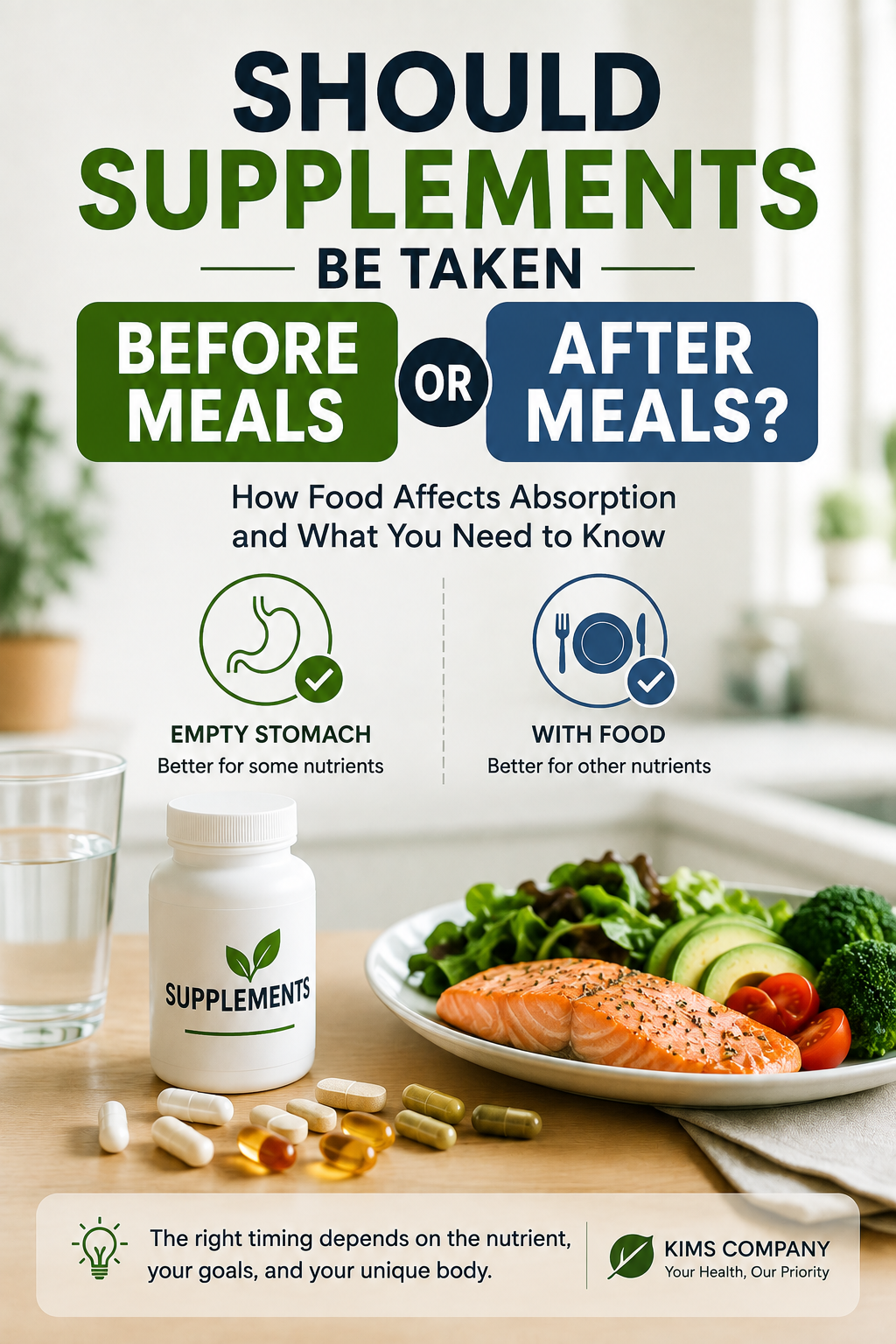
Start With Bioavailability, Not the Clock
A supplement label may say that a capsule contains 1,000 IU of vitamin D or 500 mg of vitamin C. That number tells you how much of the ingredient is in the product, but it doesn't necessarily tell you how much ultimately becomes available for use in the body.
This is where bioavailability becomes relevant.
Bioavailability broadly describes the extent to which a substance becomes available after it is consumed. With nutrients and supplements, several factors can influence this process, including the chemical form of the nutrient, meal composition, digestion, and interactions with other dietary components.
This is one reason two popular pieces of advice can both be misleading:
“Always take supplements on an empty stomach.”
and
“Always take supplements after eating.”
Neither rule works for everything.
Fat-Soluble Vitamins Are Closely Connected to Meals
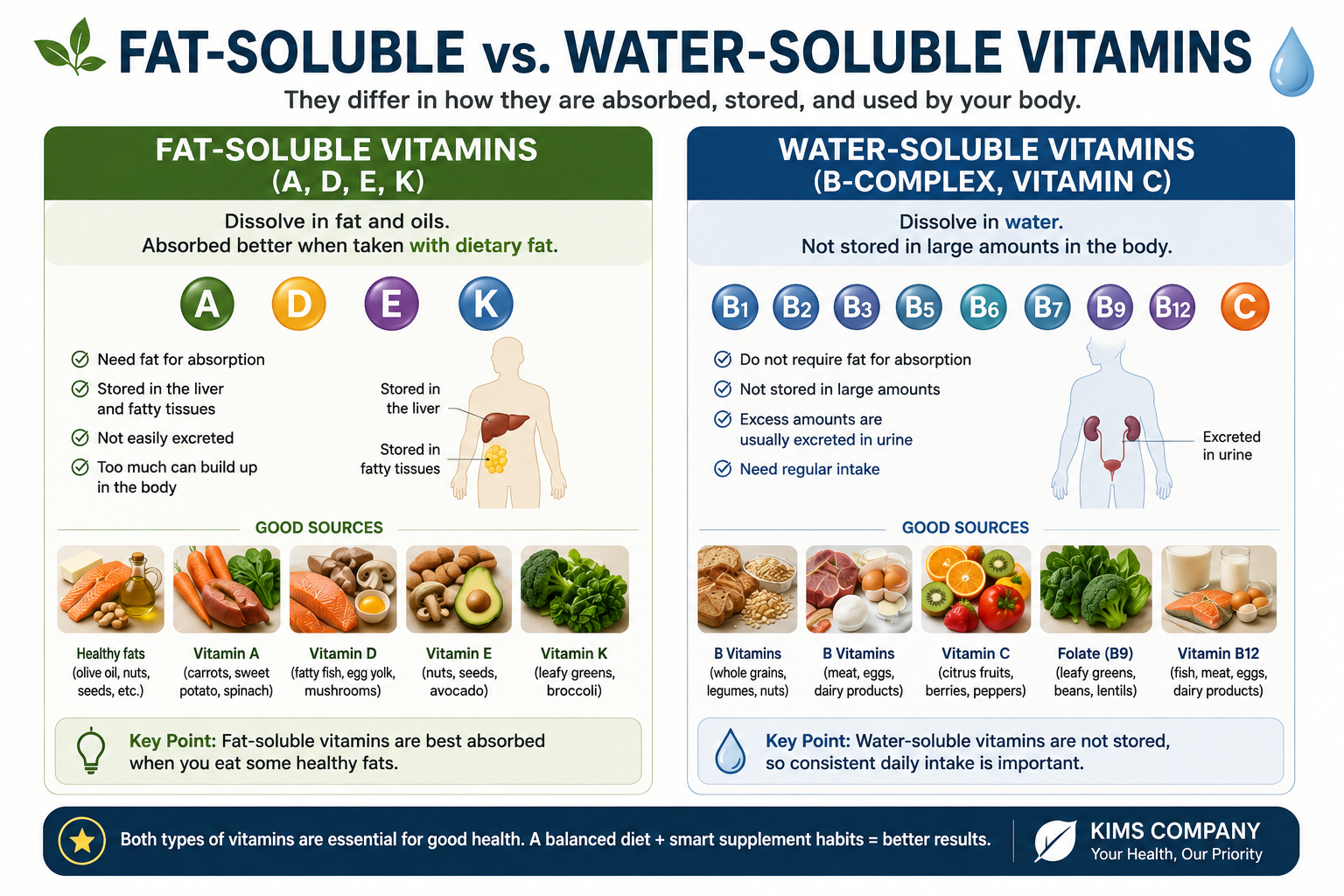
Vitamins A, D, E, and K are classified as fat-soluble vitamins.
Unlike water-soluble vitamins, their intestinal absorption involves processes associated with dietary fat. This makes meal composition relevant when deciding how to take them.
Vitamin D provides a useful example.
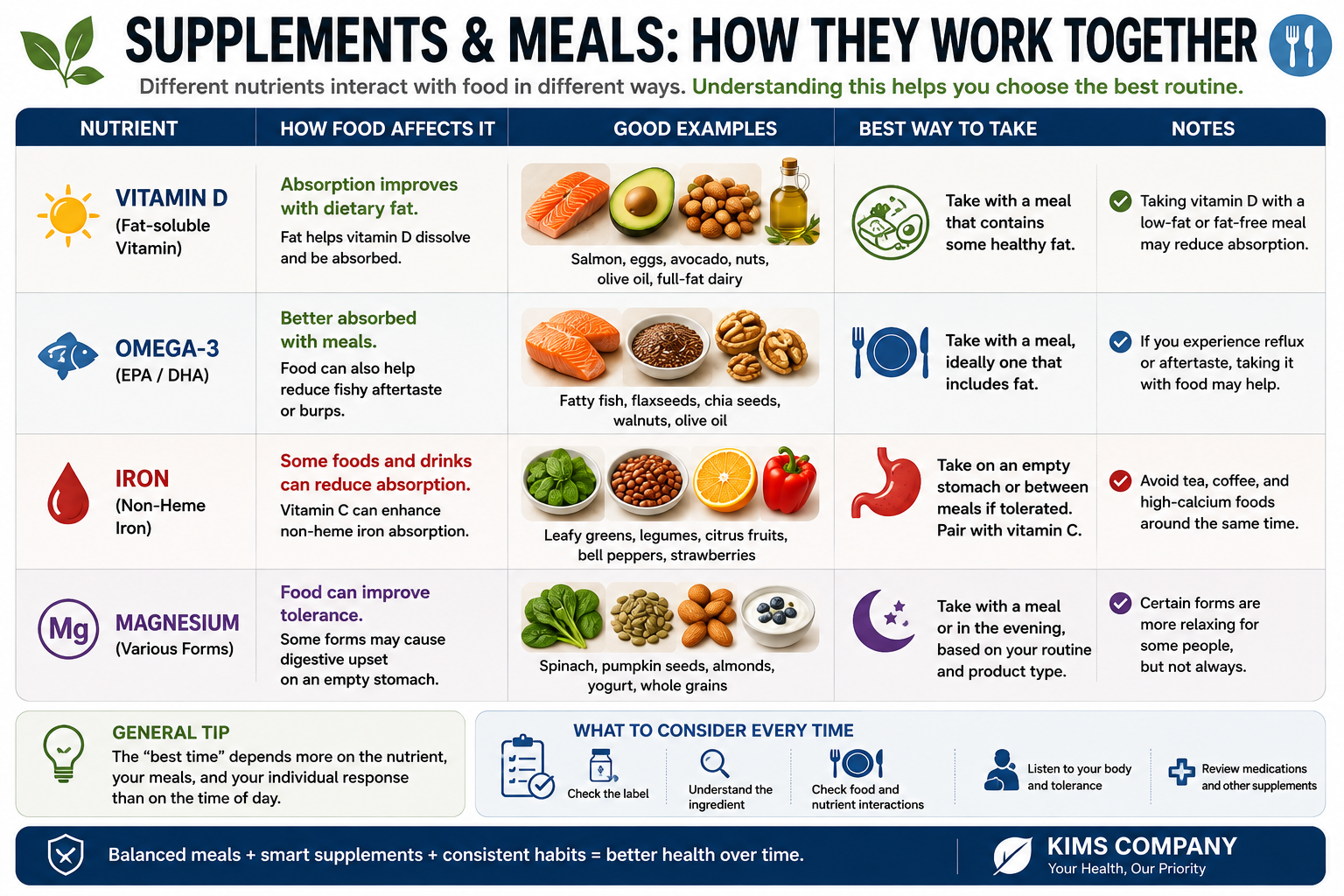
Instead of focusing exclusively on whether vitamin D should be taken in the morning or evening, it may be more useful to consider whether the dose is being taken with a meal containing some dietary fat.
That doesn't mean you need a high-fat meal.
Foods such as eggs, nuts, seeds, avocado, olive oil, dairy products, or fish can already provide dietary fat as part of an ordinary balanced meal.
For someone who skips breakfast or only drinks coffee in the morning, automatically scheduling a fat-soluble vitamin at breakfast may not be the most practical choice.
Does “Water-Soluble” Mean You Should Take It on an Empty Stomach?
Not necessarily.
Vitamin C and the B-complex vitamins are generally classified as water-soluble. Unlike fat-soluble vitamins, they don't depend on dietary fat in the same way for absorption.
This fact sometimes gets simplified online into:
Water-soluble vitamin = empty stomach.
The reality is more nuanced.
Some people experience nausea, stomach irritation, or general digestive discomfort when taking certain supplements without food.
If taking a supplement on an empty stomach repeatedly makes you feel unwell, the theoretical advantages of a particular timing strategy may be less important than finding a routine you can comfortably maintain.
The product label and any instructions from a healthcare professional should take priority over generalized internet rules.
Omega-3s: Think About the Meal Before the Time of Day
Omega-3 supplements commonly provide the fatty acids EPA and DHA.
Because these are lipids, omega-3 supplements are often taken with meals. Meal composition may influence digestion and absorption, and taking the supplement with food can also be more comfortable for some people.
There's another practical consideration.
Fish oil supplements can sometimes cause an unpleasant aftertaste, reflux, or “fishy burps.” Taking the product around a meal may help some users tolerate it better.
This illustrates a broader point:
The question may not be “Should I take omega-3 at night?”
A more useful question can be:
“Which regular meal makes it easiest for me to take this consistently and comfortably?”
Iron Requires More Attention to What You Eat Around It
Iron is a good example of why supplement timing can become more complicated than “before or after breakfast.”
Iron absorption can be affected by other dietary components.
For example, certain compounds in coffee and tea can interfere with the absorption of non-heme iron. Calcium can also be relevant when consumed around the same time.
Vitamin C, on the other hand, can enhance the absorption of non-heme iron under certain conditions.
This does not mean everyone should start taking iron with vitamin C.
Iron supplementation deserves more caution than many routine supplements because more iron is not automatically better. Whether supplementation is appropriate depends on individual circumstances, dietary intake, and sometimes laboratory testing.
If iron deficiency is suspected, discussing testing and supplementation with a qualified healthcare professional is preferable to guessing based on symptoms.
What About Magnesium Before Bed?
“Take magnesium before bed” is one of the most common supplement-timing recommendations online.
But magnesium supplements aren't all identical.
Common forms include magnesium citrate, magnesium oxide, magnesium glycinate, and several others. They differ in elemental magnesium content, formulation, and gastrointestinal effects.
For this reason, bedtime should not be treated as a universal requirement.
Some people may find evening supplementation convenient, while others may prefer taking magnesium with a meal because of digestive tolerance or simply because it is easier to remember.
The specific product directions and individual response matter more than following a rigid “magnesium equals bedtime” rule.
Taking Several Supplements? Check for Duplication First
Timing becomes more complicated when the number of bottles increases.
Suppose someone takes a multivitamin, a separate vitamin D product, a mineral supplement, and another “wellness” formula. The first question shouldn't necessarily be how to divide them between breakfast and dinner.
It should be:
Are any of these nutrients being duplicated?
A multivitamin may already contain vitamin D, zinc, magnesium, vitamin B6, or other nutrients that are also present in separate products.
The total daily amount can therefore be very different from what someone assumes by looking at one bottle at a time.
This is why reviewing the Supplement Facts panel across all products is an important part of building a supplement routine.
A Practical Way to Build a Supplement Routine
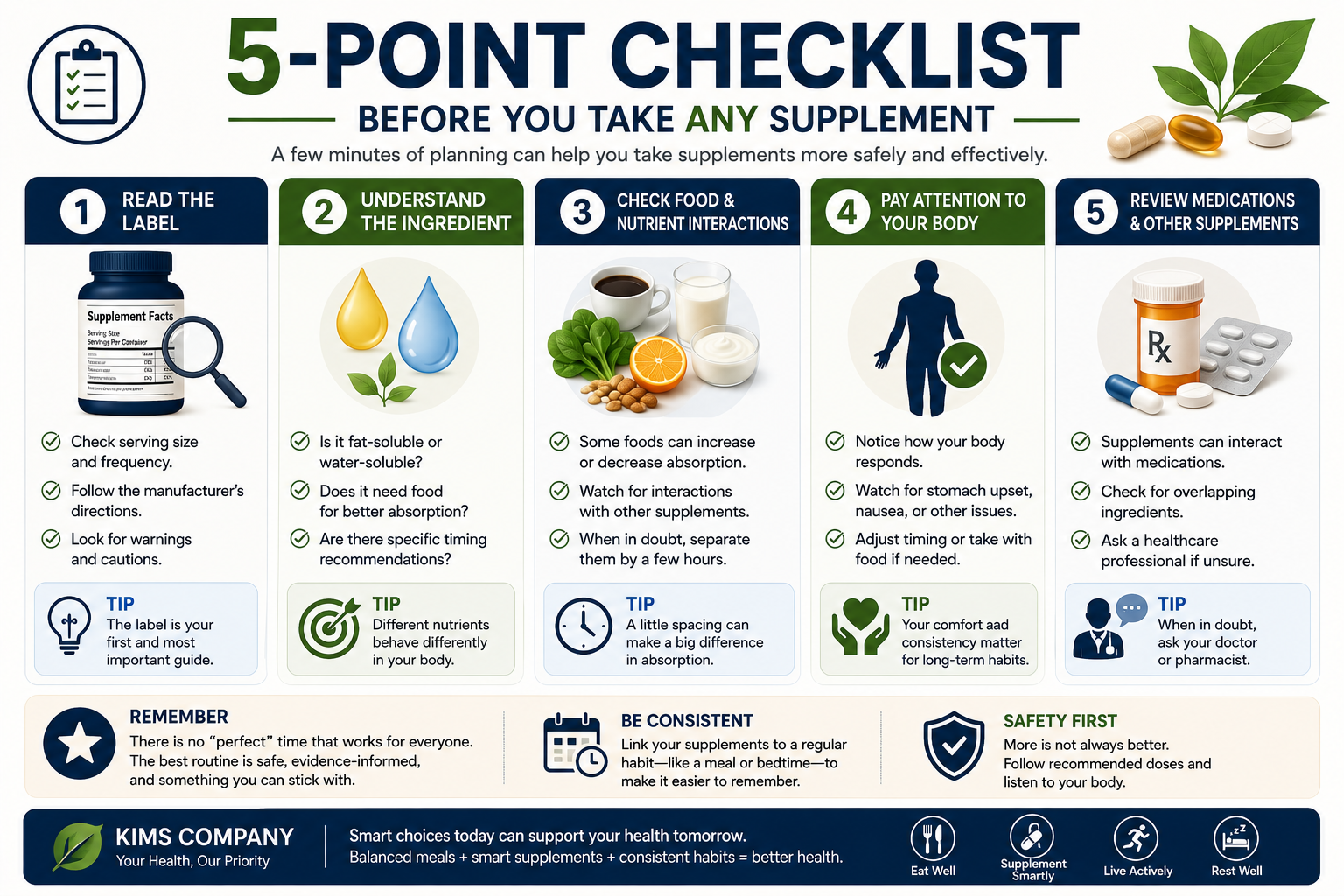
Rather than downloading a complicated supplement schedule, work through five questions.
1. What does the label actually say?
Check the serving size, frequency, directions, warnings, and whether the manufacturer specifically recommends taking the product with food.
2. Is the nutrient fat-soluble, water-soluble, or something else?
Understanding the basic properties of the ingredient can help explain why food may or may not matter.
3. Could food or another supplement affect it?
Iron is a useful example, but interactions are not limited to iron. Look at your entire supplement routine rather than evaluating every bottle in isolation.
4. How does your stomach respond?
A routine isn't very useful if it repeatedly causes nausea, reflux, or other gastrointestinal discomfort.
5. Are you taking medications?
Dietary supplements can interact with prescription and over-the-counter medications. If you regularly take medication, ask a physician or pharmacist about potential interactions rather than relying solely on general supplement charts.
Three Supplement-Timing Myths Worth Questioning
Myth 1: Morning is always the best time for vitamins
There is no universal morning rule. The appropriate approach depends on the nutrient, meal pattern, product directions, and individual circumstances.
Myth 2: An empty stomach always means better absorption
Food can decrease the absorption of some substances but improve the absorption or tolerability of others. The ingredient matters.
Myth 3: If supplements are “natural,” they can all be taken together
“Natural” doesn't mean interaction-free. Supplements can contain overlapping nutrients and biologically active compounds, and some may interact with medications.
Consistency Matters, but It Doesn't Override Safety
There is value in creating a routine you can remember.
For example, if a particular supplement is appropriately taken with food, connecting it to the meal you eat most consistently may make more sense than forcing yourself to follow an arbitrary morning or evening rule.
However, consistency shouldn't be used to ignore product-specific directions, excessive intake, medication interactions, or persistent side effects.
A useful supplement routine balances three things:
evidence, safety, and practicality.
Frequently Asked Questions
Can I take all of my supplements together?
Not necessarily. Whether supplements can be combined depends on their ingredients, doses, potential nutrient interactions, medications, and individual health considerations.
Should vitamin D be taken with food?
Because vitamin D is fat-soluble, taking it with a meal containing some dietary fat is commonly considered when planning supplementation.
Is iron better on an empty stomach?
Food can affect iron absorption, but iron may also cause gastrointestinal discomfort in some people. Follow the product instructions and individualized medical advice, particularly when iron is being used to address a diagnosed deficiency.
Does magnesium have to be taken at night?
No universal rule requires magnesium to be taken at bedtime. The formulation, product directions, digestive tolerance, and personal routine should all be considered.
What if I forget a supplement dose?
Don't automatically double the next dose. Follow the instructions for the specific product or advice provided by your healthcare professional.
How to Evaluate Supplement Advice Online
Supplement recommendations can sound very precise even when the evidence behind them is not.
When you encounter claims such as “always take this at night” or “never combine these two nutrients,” look for the source behind the recommendation.
Useful questions include:
- Was the evidence obtained from human research?
- How many participants were studied?
- How long did the study last?
- What dose and formulation were used?
- Was there a comparison or control group?
- Do other studies report similar findings?
- What limitations did the researchers acknowledge?
A laboratory finding, an observational study, and a randomized controlled trial do not provide the same type or strength of evidence.
That distinction is particularly important when health information is simplified for social media.
References and Further Reading
For reliable information about vitamins, minerals, and dietary supplements, useful starting points include:
- National Institutes of Health (NIH), Office of Dietary Supplements
- National Library of Medicine / PubMed
- U.S. Food and Drug Administration (FDA) consumer information on dietary supplements
- Peer-reviewed systematic reviews and clinical trials relevant to individual nutrients
Whenever possible, evaluate the full body of evidence rather than relying on a single study or a supplement manufacturer's marketing material.
Medical Disclaimer
This article is provided for general educational and informational purposes only and is not intended to diagnose, treat, cure, or prevent any disease.
Individual supplement needs and appropriate dosing can vary based on diet, age, health status, pregnancy or breastfeeding, laboratory results, and medication use. Consult a qualified physician, pharmacist, registered dietitian, or other appropriate healthcare professional before starting a new supplement when individual medical guidance is needed.
KIMS COMPANY
Good supplement decisions are not simply about finding the “perfect” time on the clock. Understanding the ingredient, its relationship with food, your overall intake, and your individual circumstances provides a much better foundation for making informed choices.