You have been outside for a while on a hot day.
Then the headache starts.
You feel unusually tired, a little nauseated, and perhaps lightheaded when you stand up. Your shirt is soaked with sweat, and all you want to do is sit down somewhere cool.
Is this simply the normal discomfort of a hot day, or could it be a heat-related illness?
There is no single medical diagnosis called “being overheated.” Heat can affect the body in several ways, ranging from relatively mild problems such as heat cramps to heat exhaustion and life-threatening heat stroke.
The most useful question is therefore not:
“Am I just too hot?”
It is:
“What symptoms do I have, and do any of them suggest an emergency?”
Why Heat Can Make You Feel So Sick
Your body continually produces heat, even before the weather becomes hot.
During physical activity, working muscles produce even more heat. Normally, the body releases excess heat partly by increasing blood flow to the skin and by sweating.
The problem begins when heat gain exceeds the body’s ability to get rid of it.
High air temperature, humidity, direct sunlight, heavy clothing, limited airflow, and strenuous physical activity can all increase heat strain.
Sweating also means losing fluid and electrolytes.
As the challenge becomes greater, symptoms such as thirst, weakness, dizziness, nausea, headache, and muscle cramps may appear.
This is why someone doing physical work outdoors may be at risk even when another person sitting nearby feels relatively comfortable.
Early Symptoms You Should Not Ignore
Heat-related illness does not always begin dramatically.
It may start with symptoms that are easy to dismiss as ordinary fatigue.
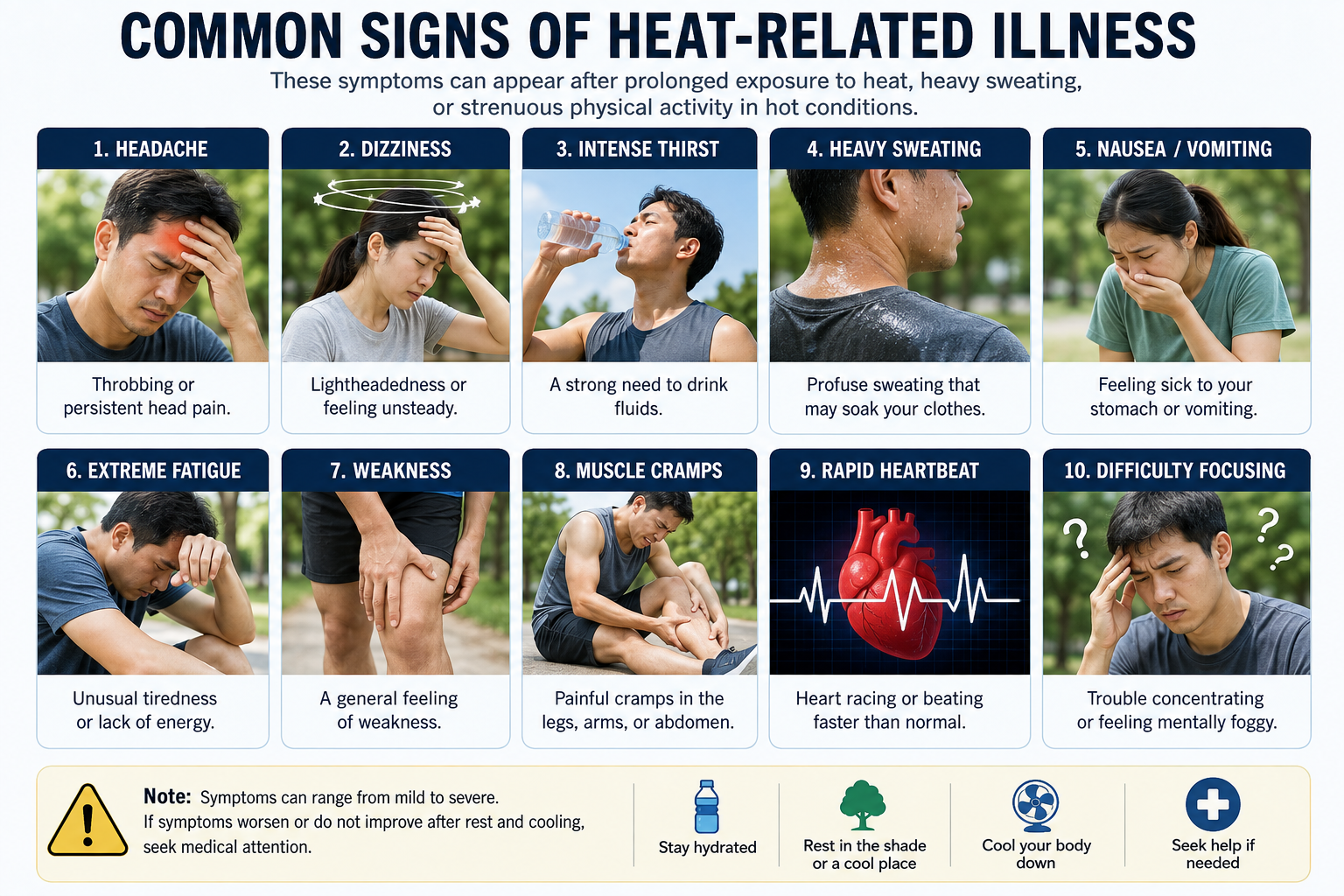
Possible warning signs include:
- Headache
- Dizziness or lightheadedness
- Unusual fatigue
- Weakness
- Intense thirst
- Heavy sweating
- Nausea or vomiting
- Muscle cramps
- Irritability
- A faster-than-usual heartbeat
OSHA lists fatigue, thirst, nausea or vomiting, dizziness, heavy sweating, and weakness among common signs associated with heat exhaustion.
The important context is what happened before the symptoms began.
Heat becomes a more plausible explanation when symptoms occur after prolonged exposure to hot conditions, strenuous exercise, outdoor work, or substantial sweating.
One symptom alone cannot tell you exactly which heat illness is occurring.
In fact, heat-related conditions can overlap.
That means the safest approach is often to stop the heat exposure first and assess the person while cooling begins, rather than spending too much time trying to assign a diagnosis.
What Should You Do First?
If you begin feeling unwell while working, exercising, walking, or spending time in hot conditions, do not keep pushing through the symptoms.
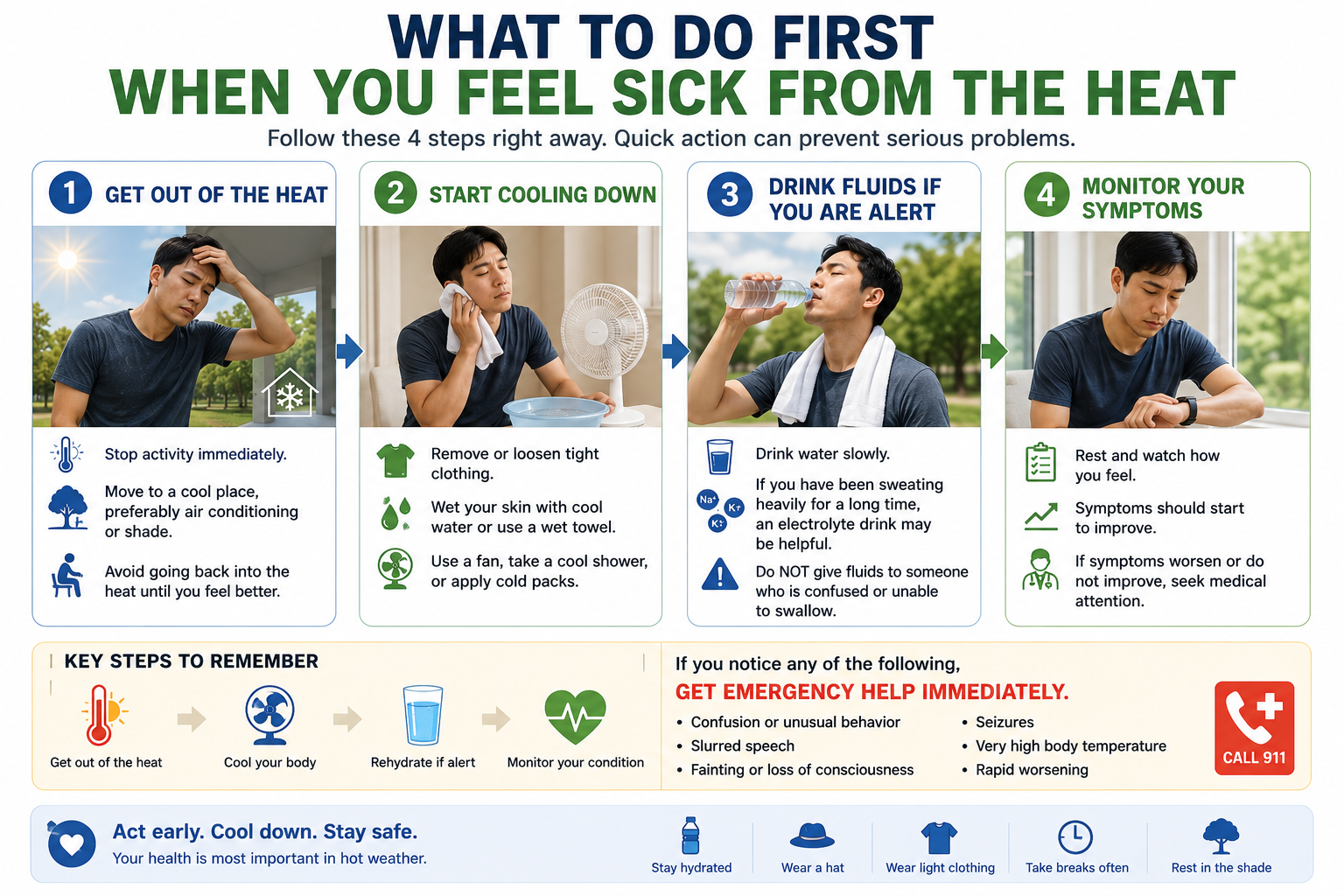
A practical first response includes four steps.
1. Get out of the heat
Stop strenuous activity.
Move into air conditioning if possible. If that is not available, move into shade or the coolest accessible location.
2. Start cooling down
Remove unnecessary outer layers and loosen restrictive clothing.
Cooling methods can include:
- Wetting the skin with cool water
- Applying cool wet towels
- Using a fan while the skin is wet
- Taking a cool shower or bath when appropriate
- Applying cold packs or cool compresses
The goal is to reduce ongoing heat gain and help the body release stored heat.
3. Drink fluids only if you are fully alert
If you are awake, thinking clearly, and able to swallow normally, begin drinking water.
Small, repeated amounts may be easier to tolerate if nausea is present.
Someone who has been sweating heavily for a long period may also benefit from fluids containing electrolytes.
However, an altered or unconscious person should not be forced to drink.
4. Watch what happens next
Do not assume that a few minutes in air conditioning means the problem has completely resolved.
Pay attention to whether the symptoms are clearly improving, staying the same, or getting worse.
Do You Need an Electrolyte Drink?
This is one of the most common questions during hot weather.
Sweat contains water as well as electrolytes, particularly sodium. Long periods of heavy sweating can therefore cause losses of both.
But that does not mean every person who feels hot needs a sports drink.
For routine hydration, water and normal meals are often sufficient.
Electrolyte-containing fluids may be more useful after prolonged heavy sweating, strenuous work, extended exercise, or when heat cramps are present.
There is also no benefit in assuming that more sugar or more electrolytes automatically means faster recovery.
The bigger issue is the person’s clinical condition.
If someone is confused, fainting, having a seizure, or unable to swallow safely, debating water versus an electrolyte beverage is no longer the priority.
That situation may require emergency care.
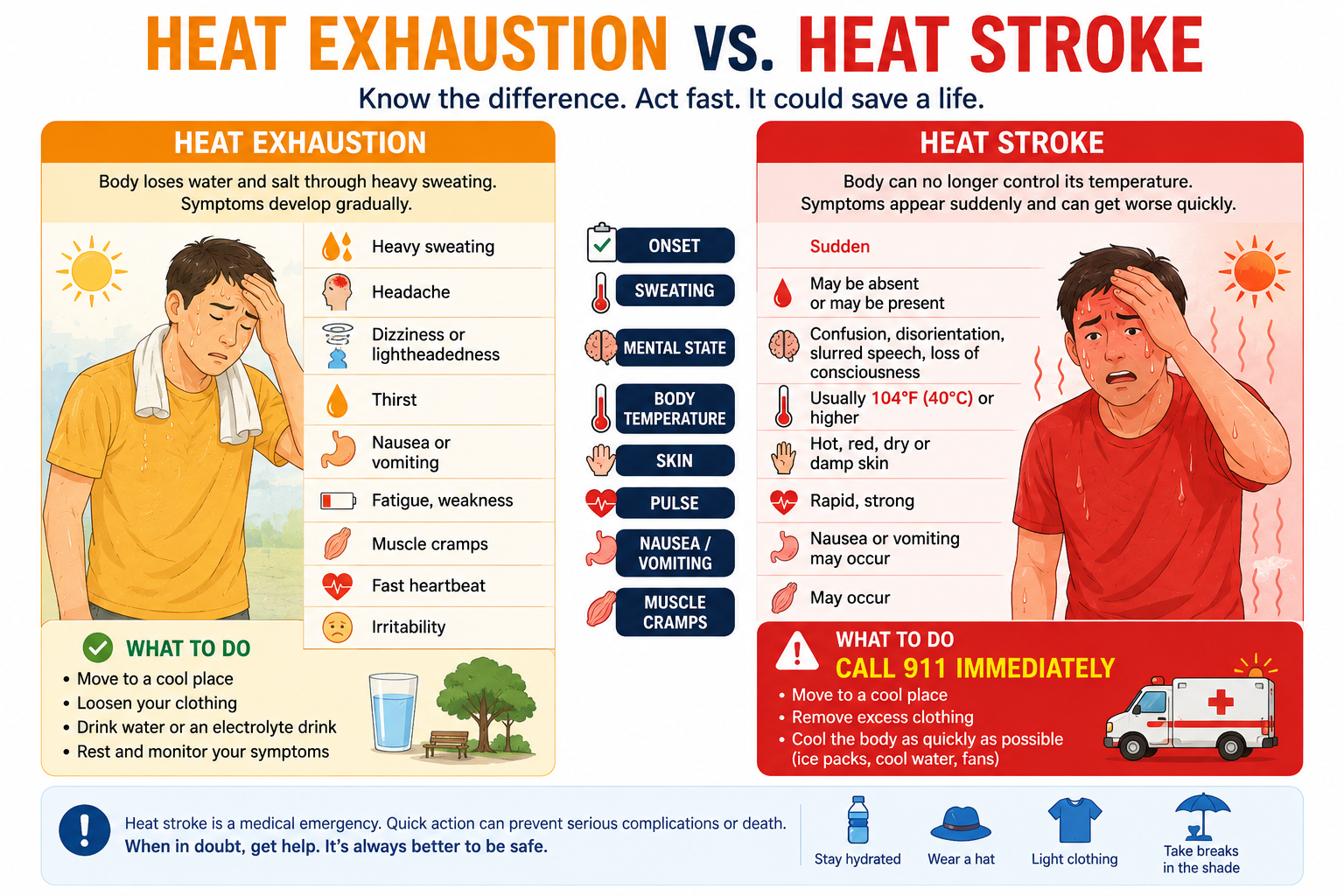
Heat Exhaustion vs. Heat Stroke: What Is the Difference?
These terms are sometimes used interchangeably in everyday conversation, but they do not mean the same thing.
Heat Exhaustion
Heat exhaustion often develops after significant exposure to heat combined with sweating and fluid or salt loss.
Typical symptoms can include:
- Heavy sweating
- Headache
- Dizziness
- Weakness
- Fatigue
- Thirst
- Nausea
- Vomiting
- Irritability
- Elevated body temperature
Someone with suspected heat exhaustion should stop activity, move somewhere cool, begin cooling, and drink fluids if fully alert and able to swallow.
Symptoms that worsen or fail to improve deserve medical evaluation.
Heat Stroke
Heat stroke is fundamentally different because it is a medical emergency.
It occurs when the body can no longer adequately control its internal temperature and neurological function begins to deteriorate.
Major warning signs include:
- Confusion
- Disorientation
- Slurred speech
- Unusual behavior
- Loss of consciousness
- Seizures
- Very high body temperature
OSHA specifically identifies confusion, slurred speech, unconsciousness, and seizures as heat-stroke warning signs.
When neurological symptoms appear after heat exposure, do not wait to see whether drinking water fixes the problem.
Emergency treatment and rapid cooling are needed.
Does Heat Stroke Always Mean the Person Stops Sweating?
No.
This is an especially important misconception.
Many people were taught that heat exhaustion means sweating while heat stroke means hot, dry skin.
Real cases are not always that simple.
A person with heat stroke may have heavy sweating or hot, dry skin.
This is particularly relevant in exertional heat stroke, which can occur during strenuous exercise or physical labor.
So this logic is unsafe:
“They’re still sweating, so it cannot be heat stroke.”
Sweating does not rule it out.
Mental status is much more important.
What About the “104°F Rule”?
A core temperature around 104°F (40°C) or higher is strongly associated with heat stroke and is commonly included in clinical descriptions.
But a person at home, at work, or on an athletic field should not delay emergency action while waiting for a perfect temperature reading.
Ordinary oral, ear, forehead, or skin measurements may not accurately reflect true core temperature under all circumstances.
If someone has been exposed to substantial heat and develops confusion, slurred speech, collapse, seizures, or loss of consciousness, the neurological abnormalities themselves are major red flags.
In other words:
Do not let one thermometer reading falsely reassure you when the person is clearly neurologically abnormal.
When Should You Call Emergency Services?

After significant heat exposure, seek emergency medical help if the person develops:
- Confusion or disorientation
- Slurred speech
- Severe behavioral changes
- Fainting or loss of consciousness
- Seizures
- Very high body temperature
- Rapid deterioration
In the United States, call 911.
If you are elsewhere, use your local emergency number.
While help is on the way, move the person into a cooler environment and begin active cooling.
Remove unnecessary outer clothing and use the fastest practical cooling method available.
Cold water, wet towels, ice packs, and active cooling with water and airflow can all be used depending on the situation and available resources.
Do not leave the person alone.
A person whose consciousness is impaired should not be forced to drink.
Why Fever Medicine Is Not the Answer
Another common mistake is treating heat stroke as if it were an ordinary fever.
With an infection, fever involves a change in the body’s regulated temperature set point.
Heat stroke is different.
The body is accumulating excessive heat and failing to dissipate it effectively.
That is why medications such as acetaminophen are not substitutes for cooling.
The essential treatment priorities are emergency medical care and rapid reduction of excessive body heat.
Who Is More Vulnerable During Extreme Heat?
Heat can affect anyone, but risk is not distributed evenly.
WHO identifies several factors that increase vulnerability, including age, health status, occupation, and the degree of heat exposure.
Groups that deserve additional attention include:
Older adults
Older adults may regulate temperature less efficiently and may not always recognize thirst or early heat-related symptoms as quickly.
Infants and young children
Children depend heavily on caregivers for hydration, appropriate clothing, shade, and access to cooler environments.
Children should never be left in a parked vehicle, even briefly.
People with chronic health conditions
Cardiovascular, kidney, respiratory, and metabolic conditions can make extreme heat harder for the body to tolerate.
People taking certain medications
Some medications can affect fluid balance, sweating, blood pressure, or thermoregulation.
Do not stop prescription medication simply because the weather is hot. Anyone concerned about medication and heat risk should discuss it with a clinician or pharmacist.
Outdoor workers
Construction workers, agricultural workers, delivery workers, landscapers, and others who perform physical labor outdoors face both environmental heat and heat generated by muscle activity.
Athletes and people exercising outdoors
Training intensity matters.
A hard workout generates substantial metabolic heat, meaning a runner or athlete can develop serious heat illness even if the air temperature alone does not appear extreme.
Why New Workers and People Not Used to the Heat Need Extra Caution
Heat tolerance changes with repeated exposure.
Over time, the body can undergo physiological adaptations known as heat acclimatization.
These adaptations can improve the ability to sweat efficiently and tolerate work in hot conditions.
But acclimatization does not happen instantly.
A person who suddenly begins a physically demanding outdoor job, returns to work after time away, or rapidly increases training during a heat wave may be less prepared for the heat load.
OSHA specifically notes that workers who are new to warm environments are at increased risk.
Gradually increasing heat exposure and workload is safer than going from minimal exposure directly into a full day of hard labor.
If You Feel Better After Cooling Down, Can You Go Back to Work?
Not necessarily.
One of the easiest mistakes is assuming that symptom improvement equals full recovery.
If you had significant dizziness, weakness, nausea, headache, or other symptoms consistent with heat exhaustion, returning immediately to strenuous activity may expose your body to the same heat load before it has recovered.
That could cause symptoms to return or worsen.
If you remain unwell, symptoms recur, or you are unsure how serious the episode was, medical evaluation is appropriate.
Practical Ways to Reduce Heat Risk
Heat illness prevention is often less dramatic than emergency treatment, but it is far more useful.
A few basic habits can substantially reduce unnecessary heat stress.
Drink regularly
Do not rely entirely on intense thirst as your only reminder to drink.
People working or exercising in hot environments may need more frequent fluids than they typically consume indoors.
Reduce exposure during peak heat
When possible, schedule strenuous outdoor activity during cooler periods of the day.
Take actual cooling breaks
Standing in the same hot environment while “resting” does not remove much of the heat burden.
Use shade, air conditioning, or another cooler environment when available.
Wear appropriate clothing
Lightweight, loose-fitting clothing generally helps the body release heat more effectively than heavy or restrictive clothing.
Pay attention to humidity
Humidity matters because sweating works best when sweat can evaporate.
High humidity reduces evaporation, making it harder for the body to cool itself.
Check on vulnerable people
During prolonged heat waves, periodically check on older adults, people living alone, and others who may have difficulty recognizing or responding to heat stress.
Four Myths Worth Dropping
“If I’m sweating, I can’t have heat stroke.”
False. Heat stroke can occur with continued sweating.
“An electrolyte drink will fix any heat illness.”
False. Drinks cannot treat dangerous neurological impairment or replace emergency care.
“I need a temperature above 104°F before I should worry.”
False. Serious mental-status changes after heat exposure are emergency warning signs regardless of whether you have obtained a reliable temperature measurement.
“If I feel better after ten minutes, I can finish my workout.”
Not always. Significant heat illness deserves adequate recovery, and persistent or recurring symptoms should be evaluated.
Frequently Asked Questions
Can heat exhaustion turn into heat stroke?
Heat-related conditions can worsen when heat exposure continues or cooling is inadequate. Because the symptoms can overlap, anyone becoming increasingly confused, disoriented, faint, or otherwise neurologically abnormal should be treated as an emergency.
Should I drink only plain water after sweating heavily?
Not necessarily. Water is appropriate for routine hydration. After prolonged heavy sweating, food and electrolyte-containing fluids can help replace sodium and other losses. The amount needed depends on the duration and intensity of heat exposure.
Is nausea common with heat exhaustion?
Yes. Nausea and vomiting are among the symptoms recognized in heat exhaustion. Persistent vomiting also makes hydration more difficult and may justify medical evaluation.
Can heat illness happen indoors?
Yes. Heat illness is not limited to direct sunlight. Hot indoor workplaces, poorly ventilated buildings, kitchens, warehouses, industrial environments, and homes without adequate cooling can all produce significant heat exposure.
When should persistent symptoms be checked by a doctor?
Seek medical advice when symptoms are severe, do not improve with cooling and rest, recur after the episode, or cannot clearly be explained. Emergency warning signs such as confusion, seizures, collapse, or loss of consciousness require immediate emergency care.
The Most Important Takeaway
Feeling weak, dizzy, nauseated, or unusually exhausted in hot conditions is not something you should automatically “push through.”
Stop the heat exposure.
Move somewhere cooler.
Begin cooling.
Drink fluids if you are fully alert and can swallow safely.
Then watch carefully for what happens next.
Most importantly, remember the dividing line that matters most:
Heat exposure plus significant changes in consciousness, behavior, speech, or neurological function can indicate heat stroke.
That is not a situation for home remedies or waiting to see whether a sports drink helps.
Call emergency services and begin cooling immediately.
References
- World Health Organization. Heat and health. Updated July 13, 2026.
- World Health Organization Regional Office for Europe. Health advice for hot weather. May 11, 2026.
- World Health Organization Regional Office for Europe. #KeepCool in the heat. June 8, 2026.
- U.S. Occupational Safety and Health Administration. Heat-Related Illnesses and First Aid.
- U.S. Occupational Safety and Health Administration. Heat Exposure: Working in Outdoor and Indoor Heat Environments.
Medical Disclaimer
This article is intended for general educational purposes only and does not provide a diagnosis, individualized treatment plan, or substitute for professional medical care.
Heat-related illness can become serious quickly. Seek medical evaluation if symptoms are severe, persistent, or worsening. If a person exposed to heat develops confusion, slurred speech, seizures, collapse, loss of consciousness, or other signs suggesting heat stroke, contact emergency medical services immediately and begin cooling while help is on the way.